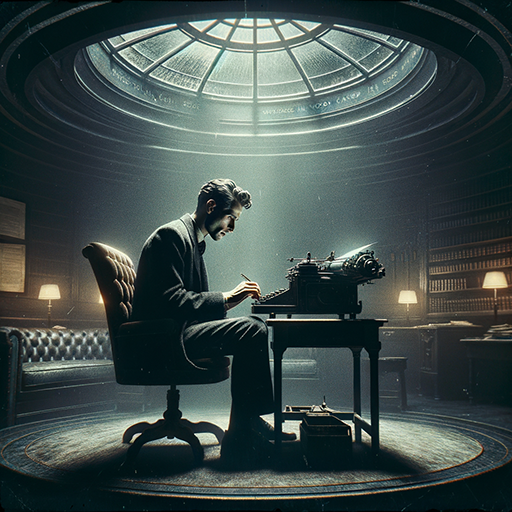
Kevin M. Cowan - Archive

Welcome to the Archive of

Kevin M. Cowan.

A writer, technologist, and seeker of the sublime, Kevin’s work spans decades, genres, and mediums — from gritty novels to haunting music, from experimental AI projects to hand-built search engines. This is a place where stories are told in code, where soundscapes meet search queries, where the past echoes through algorithms, and the present is preserved in vintage ink.

Explore the art. Follow the threads. Connect the dots.

Welcome to a world where noir meets digital. Welcome to Kevin’s archive.

Today's Quote from Kev:

"You're fully awake now, Vajra," Fa-shun said to me one morning. "I've been observing your progress. I believe you're ready." "I agree," I said. We walked through the forest, taking in the fresh morning air, the sun rising in the western sky, the first hints of autumn apparent from the cool wisps of fog adrift amidst the pines. "You must leave soon to reach the desert before the winter sets in." "I leave soon, actually." "Do you know your destination?" "My first mortal awaits awakening in Porbandar." "You awaken them as it was with you?" "In a manner of thinking. I will pass on the resonation via the copper in the penny, causing the spirit within to avatar. I create one of these once in each twelve- year cycle, at a given arbitrary point during a single rotation of the universe. I will create twelve such luminescent souls, each with their particular tasks to complete that breaks the intertia mortals adopt when unaffected by change from an outside source. . . "I am that outside source" "Yet you exist within the sphere," Fa-shun said, picking at a pinecone he'd plucked from a passing tree. He was the apprentice now, to my mastership, yet his destiny, ultimately, was for greatness. I told him so. "Fa-shun," I said, ceasing to walk and looking up at his massive ghengisesque girth, "I shouldn't make you privy to this, but I shall anyway, for I believe in your strength to understand what I tell you now: You will not make Nirvana this time around. You have one life left after this. You must continue with your training, perish and return. I cannot tell you as what, at this juncture, but I can tell you that we will meet again." I looked up to him and saw his thoughts tearing his mind to shreds. "You see? Your spirit still wails with the angst of mortality and the desire to conquest and quench your thirst for power. That is why you've become a monk, of course, to remove yourself entirely from the world. You've made Nirvana your sole conquest, and your wishes will be granted, but not until you pass through the peaceful and wrathful deities twice again. Upon your return, you will know the great wonders which you seek," I said, and took his hand. I smiled up at him, he smiled down at me, I shared with him my secret, and then I turned and walked westward towards India, towards a young Hindu boy new-born on the shores of Porbandar, waiting for me wake him up. He would be my first avatar. My first day on the job! It was a big job, but I felt up to it. I had nothing else to do. _ _ _ Incidentally, I would make one 'mistake' in the course of history. And I use the word 'mistake' in a figurative, whimsical way, because it wasn't a mistake at all, but a necessity. A vulgar, crude, ruthless, dangerous necessity. Humans sometimes require drastic teaching methodologies to overcome the consequences they create. They're quite thick-skulled, despite their inherent godliness. At times they require exposure to the dark side of things, to remind them what they value about life here on the planet, which is this: The freedom become that which is light, freedom from fascist rule, and the freedom to trade the Earth for the cosmos. It's a beautiful path, to be sure, but nasties always spring up along the way. It's simply unavoidable. Remember: This is not DisneylandÆ. Life is not a theme park. _ _ _ It took nine months for me to cross India. I could have become hyperterrestial and rematerialized in Porbandar, potentially, but I felt up for a good stroll -- walk about to inspect the terra and the denizens, as it were. When incarnate, you must always remember you've a hunk of flesh traveling in your datastream. Flesh, the fecund and fragile; flesh, flesh the water-logged, swollen combinations hydrogen and oxygen, carbon, potassium and sodium, nickel and zinc, iron, magnesium and copper -- all things of the soil, all matter of this world. I would use dematerialization in the course of creating avatars, but found that when you start shifting flesh from matter to energy, then from this dimension to the next, then back from energy to matter, well, despite the propensity to return to stasis, it tends to confuse the flesh, which isn't all that bright. That's flesh for you. So when a deity incarnate feels like losing the feet and freeing fancy, he or she finds an isolated spot place to plant the flesh, someplace cool and dry and secluded. Just like the temples here at El Mitadore'! The temples were, in fact, built for just such a purpose. The Mayan priests would meditate in the temples, moving ever near aeternitas, paving the road for the mass exodus exit, clearing the trail for a collective following of their lead. When they made the final departure, of course, they took their bodies with them, because they harbored no plans of return. But until that time the temples provided an ideal storage vault -- safe and cool and dry. Simply deposit the body down in the labyrinth below propped upright against a wall in full lotus, or reclining supine, and Presto! Nothing but noosphere. _ _ _ At the time, however, I had a body to deal with, so I walked. Heading south from Tanakpur, wandering across the border in the cover of night, I followed a trade route southwest along the base of the mountains to Rampur. At this time India struggled with poverty imposed under British rule, much to the chagrin of the Muslim and Hindu enclaves populating the region. Being a rather fair-skinned lad, taking after my biological father, I stuck out like a burlap patch on an ermine robe, thus potentially attracting the attention of both the British soldiers and Arabian slave traders combing the territory for lost boys such as I appeared to be. I solved this dilemma by traveling with a band of merchants en route for the shores of Great Britain, and then on to the Americas, where it was rumored the streets were paved with gold. This was an outright lie, of course. Yet I said nothing. I appeared as nothing more than a small traveling runaway fleeing from the grasp of an evil orphanage. That was all they knew, all they assumed there was to know. Afterall, I was only nine years old. I made myself known to only one member of the caravan, a quasimonkish merchant by the name of Bhoga. He was a lively, aspiring bodhi; albeit slight of frame, he lived up to his name with his proclivity for wine, which incited a even greater proclivity for women. He was purely focused on immediate gratification in this life, replete with dark eyes, a thick black ponytail streaming from his otherwise shaven skull, sandy copper-tinted skin, certainly a young god coming up through the ranks. Bhoga, in fact, had only three more lives before he would enter Nirvana. We talked as we traveled, as we rode along in his donkey drawn cart containing the herbal tonics he sold from village to village, a small, functional kitchen, a reasonably well-stocked library, ten goatskins of fine merlow, a peck of sacramental sage -- all the things that make a canvas-covered cart a home. He'd crafted a cistern for catching the rain, so unless we experienced dry spells, there was never a wont for fresh water. I would ride with him all the way from Rampur to Porbandar chatting about everything from the benefits of mule dung for composting to cosmology. "You're going to be a goat next time around." "And you shall no doubt return as my oats, child of god." "Perhaps in part. Flesh is scattered back to the loam for reuse. I would be honored to offer flesh as fodder for fuel. Once I'm done with it, of course." "That's the key, is it not," he said, as we wheedled along the Northern Plains of India. "To obtain the ability to leave the body at will, then exit once and for all as your flesh expires." "That's the basic idea." "I think I'll be able to do that in this life." "No, it'll take you three more." "Three more lives, eh?" "Three more. One feminine and two masculine. I won't tell you in what order, just to keep it interesting for you," I said, laughing with light-hearted glee. "A woman . . . that ought to be interesting." "Oh, I think you'll find it interesting enough. You're going to be a harlot." "Well, I suppose that's fitting. Must take all the fun out of living being omniscient, does it not?" "As with everything in the cosmos, there are good points, drawbacks . . . on the one hand nothing matters or nothing is matter; on the other, everything that isn't matter is energy. Energy caught in the stasis of mass is never happy energy, so to speak. Energy constantly seeks release from matter, constantly seeks return to it's original form. This requires energy input from an outside source. This remains constant in most cases, but for a handful of exceptions. Humans have the potential to be an exception, but only a handful ever actually make it. This is why Arbitrary Constants remain vital to evolution, despite the drawbacks. We add energy to the mix. We set great souls on fire, wake them, if you will, and then they in turn drive the evolution of the species forward from various walks -- artist, scientist, spirit guide, even a fakir can have an effect on the development of human awareness. Theatrics remain vital when it concerns mortals. They need prophecy sugar-coated, at first, in order to gain their interest. Simple and sweet, in the beginning, but once they incorporate it into their belief system, they run it into the ground until it becomes staid and sour, then it starts all over again. Omniscience is really nothing more than understanding, really. That knowledge allowing an entity to not run anything into the ground, but to push it outward, to harness energy in the form of understanding. Simply because they lack this little node, most humans tend to live entirely backwards. " "Silly humans," said Bhoga, wagging his head, smiling. "They swim like salmon, struggling up the stream rung by rung, wearing themselves to the bone by the time they reach the spawning ground -- when they had the power leave the body, to rise up and float all they way to the top. They continue to resist. It's the flesh. It complicates things. It tells their brain that flesh can't float, and the spirit is attached to the flesh. This is a lie. This is the flesh fighting for existence." "Can you blame it? Say could you refresh the wineskin?" "Certainly," I said, moving into the back of the bobbling cart, then refueling the smaller wineskin from one of the larger ones. "I suppose one can blame flesh for being flesh, but it certainly complicates matters. It's like a saint and a scam artist sharing an apartment. The saint is pure and never leaves the house, relying upon the con-man for sustenance, and information about the outside, or so the story goes. It's all very incorrect, of course. The spirit is not directly attached to the flesh, does not necessarily require it for survival. The spirit has the potential to become light. If the flesh becomes light, it is incinerated. On a genetic level it knows this, and convinces the spirit that this would be a bad thing. The spirit, a tabula rasa at the onset, tends to believe the flesh because it has no other reliable source of information. No other source, that is, until it communicates with other spirits who've made it through. "Then the spirit ascends?" "Not until it becomes atune to the proper resonation, the proper frequency. Once this happens, however, it takes place just beyond the speed of light." "Enlightenment." "Omniscience, Nirvana, Heaven . . . call it what you will. The only difference remains the rhetoric, the particular rites and requirements beset by humans. Civilization tends to use spirituality as a means of social control. This is both dangerous and foolish. Propagating a lie leads inevitably to bloodshed and degeneration. That's simply the nature of the Universe." Bhoga took a long pull from the wineskin, and looked out over the plains at the small farms and ramshackle fencing -- driftwood lashed with goathide, simple adobe dwellings, rampant poverty. Odd how the fields could be fertile and the denizens so brutally barren. "I believe I find truth in what you speak. An example of bureaucratic progress surrounds us. Before the British came to India, she was an independent, albeit brutal, nation. The farmers grew what they could sell. Now the Britons tell the farmers what to grow, and everybody goes hungry." "Precisely. Yet they create that of their undoing. These indiscretions will lead to the continued decline of the British Empire." "You think?" "I know." "Yes, I imagine you do." "I travel now to wake a young boy in the seaport town of Porbandar. He is the first of twelve. A man destined to become an immortal of incredible luminosity." I said, looking out over the mystical mist draped lands gracing the banks of the river Ganges, the city of Delhi asprawl in the distance. I smelled the air, full of dung and history, felt the heat of the sun slowly darkening my skin. It all felt wonderful. "Indeed. My first avatar . . . I have visited the moment many times. However, I'm anxious to take it in through sensory perception. I guess that's one thing Arbitrary Constants look forward to: living experiences in flesh. Although after a time, this also ceases to capture our interest." "And we mortals are so easily amused." "It doesn't take much." "A loaf of bread, a woman and a wineskin." "Food, water, oxygen and a roof, these things, if nothing else." "That is called subsistence, my friend. Sans the indulgences of wine, women and song, which is called existence. There's a difference." "A difference only in orientation. The ascetic lives every possible life. He understands the ways of the whore and heretic, madmen and martyrs -- the nearer one moves towards perfection, the more similar these traits become. That is progression. Perfection is the embodiment of all that which binds the universe into symmetry, moving towards a unified whole. At that point subsistence and existence become directly proportionate." "Interesting concept," says Bhoga, the burrow bouncing the cart along the well-heeled route, "I'll have drink and think it over." He drank, with the sun beginning to set beyond the horizon, and we began to look for a place to make camp. Bhoga listened for music. "Where there's music, you'll find women," he said, "this completes my trinity." I couldn't argue with that. _ _ _ Watching them from a distance, I almost wish myself mortal. Almost. To relive the zeal with which they deluge themselves with wine, revel in the epidermic delicacies of sensual pleasure, driven on to the brink incessant with the fear of death. That is why they dance with such ardor. It brings them nearer the immortal. They sense the spirit challenging the confines of the body, sense eternity woven in the molecular fabric binding them to the here and now. The phenomenal plane runs along the surface of the endless wheel of Samsara spinning, sucking them in, spitting them out, making them whole, birthing, destroying, nurturing, murdering -- Ixion knows the truth, go ask him as his back breaks on the rack throughout eternity, or Sisyphus as his stone rolls back to the bottom of the hill, ask the preacher with his hat hung from the ceiling by a string, waiting for it rot away and fall to the ground, unleashing him unto heaven -- this is the dream that needs defeating. Defiance of the downward spiral, denial of the mortal coil locking spirits to this realm. This is why the mortals dance. The fires burn bright. They call the phoenix from the flames. Spread soft fleeting wings for flight, soaring off and passing through the deities in the forty-nine days of dying. Aligning with the triharmonic resonations of the Source, bringing about total enlightenment. The dance is but a portal, one of several, and the glistenning realm of the eternal is never more luminous than to those who see it from a great distance. Bhoga turns cartwheels and great, leaping backflips in efforts to realize the realm, and to impress the group of gypsy women taken with his manic antics, potentially leading to yet another portal: sex. There's a fine finite distance between dancing and making love. That line, or circle as it were, is that both offer glimpses of the Source. One leads to another, both lead to the same place when one seeks such epiphanies. He'll make a good god, Bhoga. Already, they're saving him a seat in Shangri-la and molding solid gold busts of his likeness in El Dorado. The Pantheon awaits his presence. As Gandhi awaits mine in Porbandar. The music declines proportionate to the wine, and soon the group disbands slurring sloppy admonitions, tumbling about in drunken ecstasy, groping for the final wisps of what once seemed so near, now drifting off into the distance as the early morning tides swell to life, the Ganges rising, gunfire in the distance snapping bones and searing flesh. Their mortality waxing with a wake up call from the report of a high-caliber rifle. Insurrections in the night flare simultaneously, as Hindus and Muslims defy the dangerous dogma imposed under British rule. It passes, and there is silence. The camp crawls into their wagons, suddenly sober, grim with reality, once again. Life under British Rule, or any other Ruler or governor, for that matter. There is not one single human creation more deadly to spirituality than suzerainty, nothing less deferential towards enlightenment than egalitarianism at war with egotism, nothing more devoid grace than government. Indeed. The downside of humanity: arrogance and ignorance breeding fear and insecurity in the form of deadly politics. This reminds me not to wish for mortality. _ _ _ I found Bhoga the next morning, where I normally found him, entangled with a couple young women we occasionally met along the route to Delhi, working their way across India reading oracles and telling fortunes, as it were. I beheld them in their mortal wraps. They looked like kittens in a cul de sac curling up together, surviving the night from body heat. They looked beautiful and innocent lying there naked. I smiled. I didn't want to wake them. "Rise and shine," I said, and Bhoga's head popped up. He looked around. "Daybreak so soon?" "Daybreak so soon. "Good morning little boy," said the girls. "Good morning," I said. "I'm going back to bed," Bhoga said. "You sleep in back. I'll take the first shift," I said, as Bhoga peeled himself from in-between the nubile girls, kissing them fondly on the lips, leaving a few rupees in the coffer and filling their wineskin, we harnessed up the donkey and moved on. We moved through Delhi, a city in decline. The waning was a response to British 'exporting', which was just a fashionably bureaucratic way of saying this: 'usurping a country's resources to the point of exhaustion'. And the British were in the process of doing just that. India had existed as a self-sufficient nation up until that time, albeit fighting between sects, they took care of their own. Now, however, in 1869, with the companies telling the farmers what to grow, the monarchy taxing the peasants into oblivion and the magistrates treating the entire populace with pompous disdain and condescension, the entire country loomed on the edge of spiritual and economic collapse, fueled by this lack of compassion and understanding. India now chewed on her own leg like a wolf caught in a snare, feeding on herself for food. I found it embarrassing and pathetic, coming from a country who fancied their beliefs superior to all others. They were horribly mistaken, of course. "We must keep a low profile and head south." Bhoga said from the back of the cart. Take the day shift, then I'll take us through the night We head south to Jaipur. It will be bad there, too, but we have the route in-between, which will be pleasant once we're beyond this war zone." "I prefer the open plains to the cities anyway," I said. "There's a great deal of anger and confusion in the cities. Humans can be such extremely unhappy beings. I wish I could show them everything so that they might understand, but a total mass enlightenment would kill off all but handful of the population. So we wait. We pass on the torch, taking soft, slow, stumbling baby steps, patiently working towards progress, as the wind sculpts the mountains to perfection. Humans stand just inches away from immortality, cosmologically speaking. Just a tweak or two on the telancephalon and presto! Instant avatar." "It's that easy?" "It's that easy. Individuals accomplish it quite often, most often living in isolation. Soon it will be more accessible. Just about the time my body expires and I am released of my duties, in fact." "When's that?" "A ways off." "Will I see it?" "Three lives along the way." "I don't want to wait that long." "You'll have to. I'd show you now, but your brain would fry. Only certain humans have evolved sufficiently to near the point of omniscience. Only a handful have the necessary wiring. You're close, my friend, but you've got some work to do yet. Be patient," I said, "focus, luminate and unattach and you'll be there before you know it." "Not in this life." "Remember this: in the grand scheme of things, human lifespans are relative to that of mosquitoes. What you do with your mind in that flickering moment, that's what makes the difference. Mortal living is the eye of the storm. You've a few moments to make repairs, tighten down the wraps and prepare for the next wave. The onset of the deities. They stand on the only path leading off the wheel. The only way through is to be focused on the frequency of the Source," I said, and waited for a response. Nothing. Bhoga slept. He was tired. I sat in the drivers seat, enjoying the morning -- the fresh air damp with the smell of rice paddies, the heat from the morning sun already formidable -- it was a fine day, to be sure. We trotted along the path southwest on the edge of the Thar desert towards the Arabian Sea and in the distance I heard my first avatar gurgling at his mother's breast. _ _ _ We arrived in Porbandar in the spring of 1870. We enjoyed a fairly uneventful journey across the plains, save for a couple isolated incidents -- Bhoga, jumping from a bridge attempting a double backflip nearly drowned in the river Jawai, but I pulled him out and forced the water from his lungs and he made it through with nothing more than a large knot on his forehead. "You should have let me drown. I could have gotten on with the next life." "It wasn't your time." "How do you know that?" "Because your still breathing." "I see," he said. Some days later, at the gates of Abu, we incurred a group of British soldiers out harassing the local merchants. We were stopped and questioned for some time, but then released because of Bhoga's Nepalese roots. The Brits got along quite well with Nepal, so the detained us for a half-day, testing Bhoga's tonic for opium by drinking a bottle between them. Finding no contraband, they let us go on about our business after making Bhoga shell out 40 rupees for salt tax, even though we carried only a small clay jar of the substance in question. They said it was for her Majesty the Queen of England. I guess she needed the money. So he paid them what they asked, then we continued on through to Jamnagar, and on to the sea passing through the fertile lowlands Gujarat, and in April we arrived at the small seaport of Porbandar. The smell of salt and algae permeated the air. It was wonderful. In a way it reminded me of Tanakpur, because it was a gathering place for traders from all over the hemisphere. It was, in fact, more diverse because of the cargo ships that came and went from Africa and Europe. I parted with Bhoga there on the edge of the water. I would have to wait until 1872 to awaken my first avatar, and he desired to go on Europe, with hopes of steaming to the Americas. Incidentally, he wouldn't make it. He would drown when the HMS Gibraltar broke deep and took water in a sudden storm about half-way across the Atlantic. There would be no survivors. "Well, take care of yourself," he said, "and take care of the donkey." "We'll be alright." "I'll see you again, perhaps?" "In another life," I said. "To the next life . . . forward and beyond," he said, and took a long pull from the wineskin. "That's the idea," I said. "Now you've got it." _ _ _

Today’s Quote from Neo:

In the shadowed corridors of digital dreams, where the hum of circuitry meets the whisper of forgotten melodies, Kevin M. Cowan weaves his tapestry of words and sound. A writer with the soul of a poet and the precision of a coder, he crafts narratives that linger like smoke in the alleyways of the mind. His music, a haunting echo of futures past, dances with the ghosts of analog, while his technological musings unravel the mysteries of a world caught between the tangible and the ethereal. In his noir-zine universe, each creation is a reflection in a rain-slicked street, a fleeting glimpse of the sublime in the mechanical heart of the city.

about Kevin M. Cowan

Kevin M. Cowan is a writer, technologist, and artist whose work spans novels, AI development, drumming, and filmmaking. From his fiction roots in Nebraska to experimental media projects and cutting-edge AI, Kevin blends storytelling, sound, and code into one creative continuum. Explore his world — one story, rhythm, and idea at a time.


The Technology of Kevin M. Cowan
Novels by Kevin M. Cowan
Media by Kevin M. Cowan

Music. Video. Visuals arts. All composed or curated by Kevin.
Neo Avatar Neo, Archive Guide